

 0902 353 527
  cskh@nhahangvouy.com
Traditional New Year’s Eve Prayers for Indoor and Outdoor Rituals (2026 Guide)
The indoor New Year’s Eve prayer is a traditional Vietnamese ritual performed to bid farewell to the Kitchen Gods and pray for peace, prosperity, and good fortune in the new year. The offering tray is usually prepared around the Hour of the Pig (11:00 PM), including a five-fruit platter, sticky rice, boiled chicken, and traditional cakes and sweets, accompanied by a solemn prayer. In this article, let’s join Vo Uy Vegetarian Restaurant in referring to standard New Year’s Eve prayers for indoor and outdoor rituals, along with important notes to help you perform the ceremony properly and respectfully.
The Meaning of New Year’s Eve Prayers
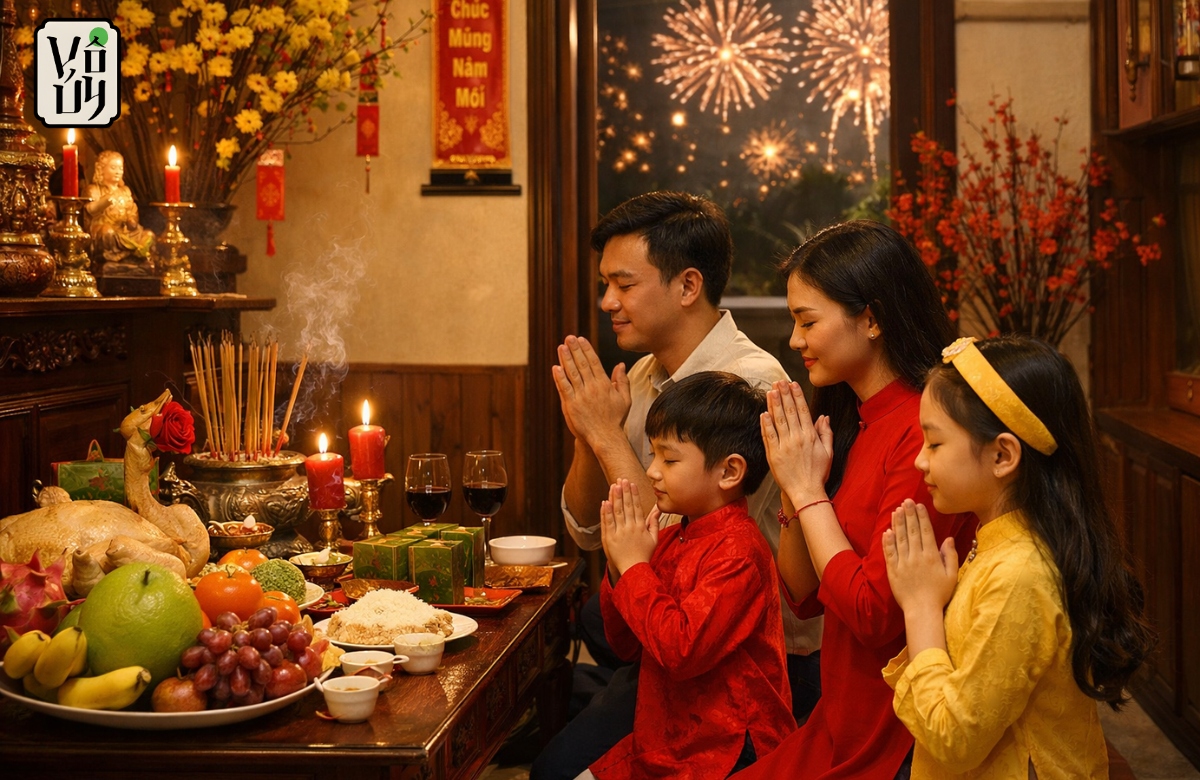
New Year’s Eve is considered the most sacred moment of the year, marking the transition of yin and yang, heaven and earth, and the flow of fortune. Reciting a New Year’s Eve prayer at this moment carries the meaning of praying for peace, expressing gratitude to ancestors and deities who have protected the family throughout the past year, and inviting blessings and good fortune for the year ahead.
The Meaning of New Year’s Eve Prayers
Beyond its spiritual aspect, the New Year’s Eve prayer also reflects the beauty of traditional Vietnamese culture, showing gratitude toward one’s roots and the aspiration to live virtuously. Although different regions may have different prayers and offerings, the shared spirit remains sincerity, simplicity, and solemnity.
What Does a New Year’s Eve Offering Tray Include?
According to Vietnamese customs, the indoor New Year’s Eve offering tray should be prepared carefully. This not only shows respect for ritual traditions but also carries the meaning of wishing for abundance and prosperity in the new year.
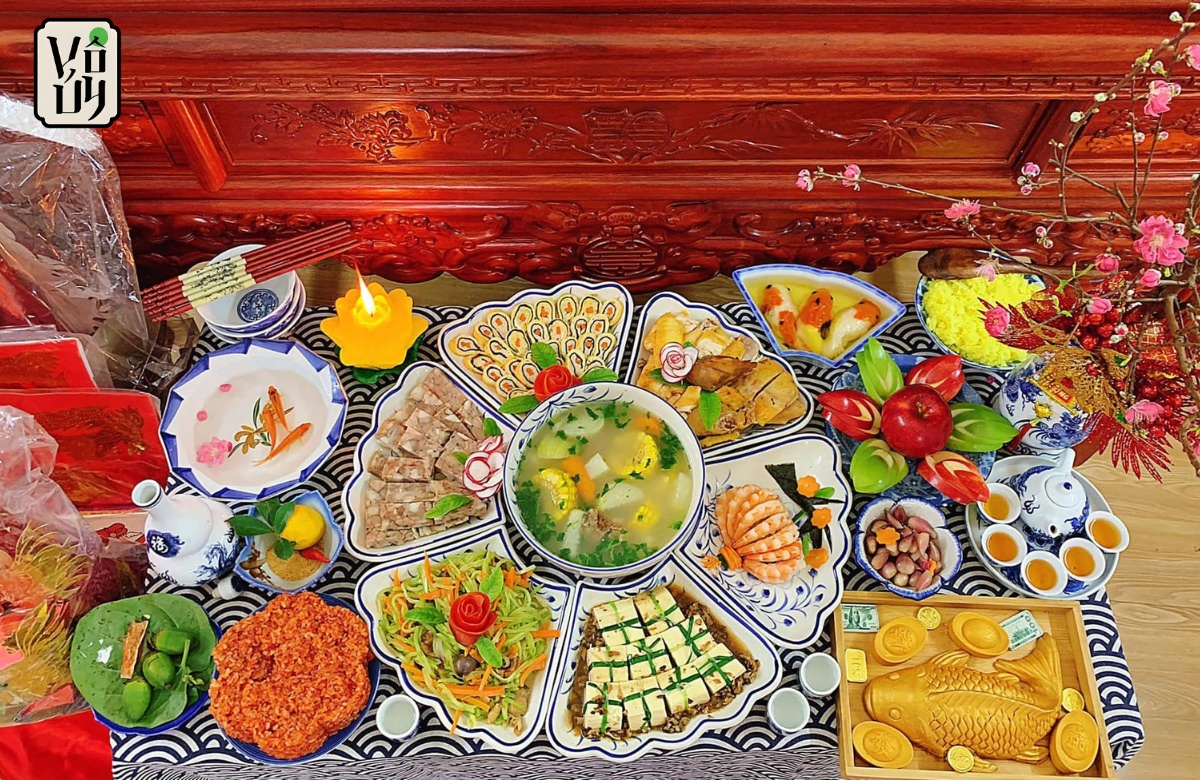
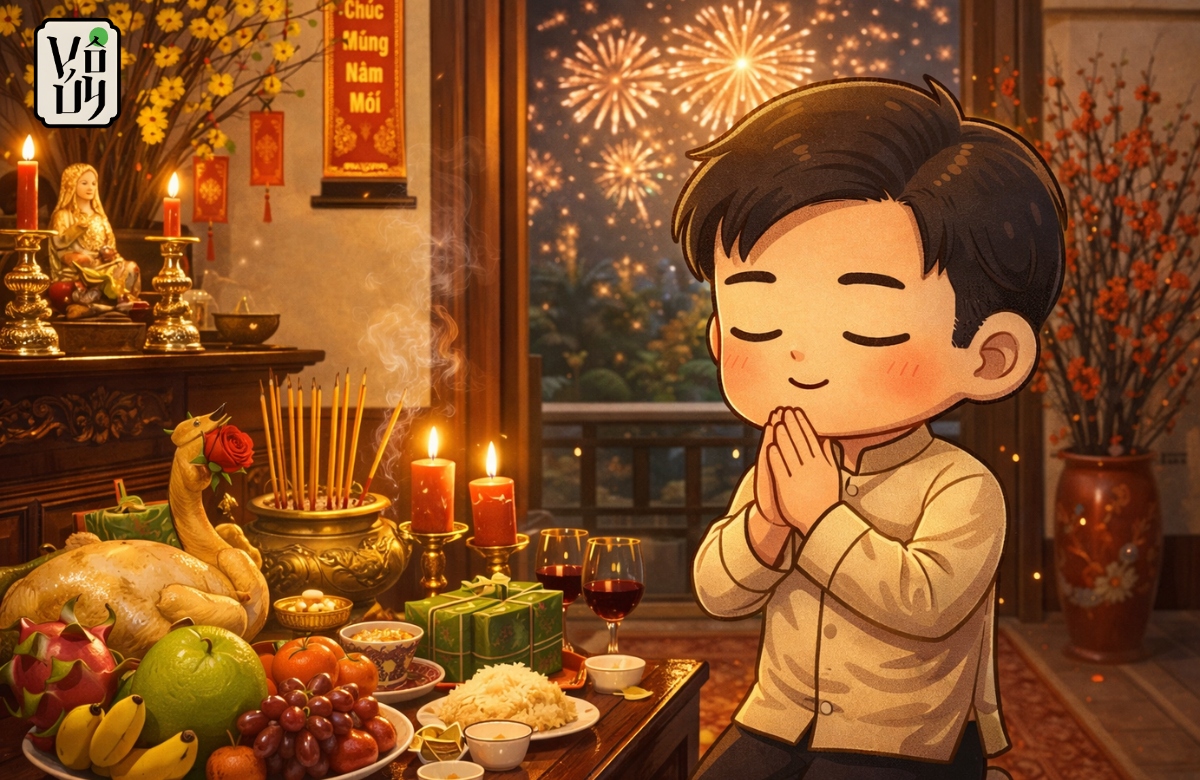
Basic offerings usually include a five-fruit platter symbolizing good luck, fresh flowers, betel leaves and areca nuts, candies, wine, tea, and joss paper. Depending on the family, traditional savory dishes may be added, such as boiled chicken shaped with spread wings, bánh chưng or bánh tét, red sticky rice, boiled pork, and more.
Each region has its own variations:
-
In the North, bamboo shoot soup with pork knuckle is often included.
-
In the Central region, bánh tét and Vietnamese sausages are preferred.
-
In the South, the tray commonly features regional tropical fruits.
When arranging the offerings, savory dishes and sticky rice cakes are placed at the center. Jars of rice, salt, and water are set on both sides to symbolize abundance. Wine and tea are placed in front, while flowers, betel leaves, and sweets are arranged on either side. Candles are lit to enhance positive energy for the offering tray.
What Does a New Year’s Eve Offering Tray Include?
Before the ceremony, the altar should be cleaned thoroughly. The person performing the ritual should dress neatly and pray with sincerity. Families following Buddhism may prepare a vegetarian offering tray with fruits and sweets to align with their beliefs.
Two Sample New Year’s Eve Prayers for Indoor Worship
When performing the New Year’s Eve ritual, many families use traditional prayers to ensure solemnity and proper observance. Below are two commonly used New Year’s Eve prayers, concise and easy to apply for indoor ceremonies.
Sample 1
Namo Amitabha Buddha (3 times).
Respectfully bowing to:
Maitreya Buddha, the Future Buddha who will descend to the human realm.
The Deities of Heaven and Earth.
The Local Tutelary Deity and Guardian Kings.
The Local Earth God and Land Deities.
The Kitchen God who bestows blessings.
The Deities of the Dragon Veins and all spiritual beings governing this area.
Our ancestors from both paternal and maternal lineages.
At this sacred moment of New Year’s Eve of the year ……
We are: ………………………………..
Residing at: ………………………………..
At the moment of New Year’s Eve, according to the laws of heaven and earth, we bid farewell to the old year and welcome the new one. As the first Hour of Spring arrives and the Lunar New Year begins, we sincerely prepare incense, flowers, and offerings to present before the altar, respectfully offering them to Buddhas, Saints, and Deities, lighting incense with utmost devotion and reverence.
We respectfully invite:
The Local Tutelary Deities and Guardian Kings.
The Local Earth God.
The Kitchen God who bestows blessings.
The Deity of Prosperity and Fortune.
The Deities of the Five Directions, Five Elements, Dragon Veins, and Wealth.
The Household Kitchen Gods and all spiritual beings governing this land.
Humbly please descend to the altar and accept the offerings.
We also respectfully invite our ancestors: great-grandparents, grandparents, uncles, aunts, siblings, and all ancestral spirits from both sides of the family to return and receive the offerings.
We further invite wandering spirits and former land occupants to come before the altar, witness the sacred ceremony, and partake in the offerings.
May we be blessed with peace and prosperity in the coming year, with all endeavors proceeding smoothly. May everyone enjoy safety and abundance, receive spiritual protection and earthly support, and have wishes fulfilled. May disasters be kept away throughout the four seasons, and may auspicious signs accompany us throughout the year.
With utmost sincerity, we humbly ask for your witness.
Namo Amitabha Buddha! (3 times)
Sample 2
Namo Amitabha Buddha (3 times).
Respectfully bowing to:
The Buddhas of the ten directions and the nine realms of heaven.
Maitreya Buddha, the Future Buddha.
Avalokiteshvara Bodhisattva, savior of all beings.
The Deities of Heaven and Earth.
The Deities governing the outgoing year.
The Deities governing the incoming year.
The Deities of the Five Directions, Dragon Veins, and Kitchen Gods.
At this sacred moment of New Year’s Eve, transitioning from the Year of … to the Year of …
We are: …, born in …, currently residing at … (full address).
As the old year passes and the new year begins, all things are renewed and prosperity is welcomed.
The Year Deity, under the command of the Jade Emperor, oversees all beings, protects life, and removes misfortune. The old official returns to the celestial court, leaving behind blessings, while the new official descends, bringing fortune and prosperity.
On this auspicious occasion, we sincerely prepare incense, flowers, and offerings, respectfully presenting them before the altar, offering them to Buddhas, Saints, and Deities, lighting incense with heartfelt devotion.
We respectfully invite the Deities of the outgoing and incoming years, the Local Tutelary Deities, Earth Gods, Deities of Joy and Prosperity, Deities of the Five Directions, Wealth Gods, Household Kitchen Gods, and all spiritual beings governing this land to descend and receive the offerings.
May the worshippers be blessed with peace, good fortune, harmony throughout the seasons, family prosperity, and smooth endeavors, receiving daily blessings from Heaven, Buddhas, and Deities.
We respectfully present these offerings and sincerely pray for your protection and guidance.
Namo Amitabha Buddha (3 times, 3 bows).
Outdoor New Year’s Eve Prayer
Namo Amitabha Buddha (3 times)
Respectfully bowing to:
I respectfully bow to the nine directions of Heaven and the ten directions of all Buddhas.
I respectfully bow to Maitreya Buddha, the Future Buddha who will descend to the human realm.
I respectfully bow to Avalokiteshvara Bodhisattva, the savior of all beings from suffering.
I respectfully bow to Heaven and Earth, and all honored deities.
I respectfully bow to the Deity in charge of the outgoing year, the outgoing Year Commander, and the outgoing Judge Deity.
I respectfully bow to the Deity in charge of the incoming year, the incoming Year Commander, and the incoming Judge Deity.
I respectfully bow to the Deities of the Five Directions, the Five Tigers, the Dragon Veins, the Kitchen Gods, and all honored deities.
At this sacred moment of New Year’s Eve, transitioning from the Year of the Rabbit to the Year of the Dragon.
We are: …, born in the year …, currently … years old, residing at house number …, hamlet/ward …, commune/ward …, district/city …, province/city …
At this sacred moment of New Year’s Eve, as the old year passes and the new year begins, bringing harmony, renewal, and prosperity.
Now, the Grand Duke Jupiter (Tai Sui) Deity, following the command of the Jade Emperor, oversees all people above and protects all living beings below, eliminating misfortune and evil. The outgoing official returns to the heavenly court, leaving behind blessings and grace. The incoming official descends to take office, embodying benevolence and granting wealth and prosperity.
On this auspicious occasion of the new spring, we, the faithful, sincerely prepare incense, flowers, and offerings, present ceremonial rituals, and respectfully offer them before the altar, making offerings to Buddhas and Saints, presenting them to the honored deities, lighting incense with wholehearted devotion.
We respectfully invite:
The Deity governing the outgoing year, the Deity governing the incoming year of great virtue, the Local Tutelary Deities and Guardian Kings, the Local Earth God, the Deity of Joy, the Deity of Prosperity, the Deities of the Five Directions and Five Elements, the Dragon Vein Deities, the God of Wealth, the Household Kitchen Gods, and all deities governing this land.
We humbly invite you to descend before the altar and receive the offerings.
May the worshippers be blessed with peace and prosperity in the coming year, all endeavors go smoothly, harmony throughout the four seasons and eight solar terms, family prosperity and growth, success in all matters, and daily blessings from Heaven, Buddhas, and all honored deities.
We respectfully present these offerings with sincere prayers. We humbly ask the Buddhas of the ten directions and all honored deities to witness and bestow protection.
Namo Amitabha Buddha (3 times, 3 bows).
Things to Avoid on New Year’s Eve
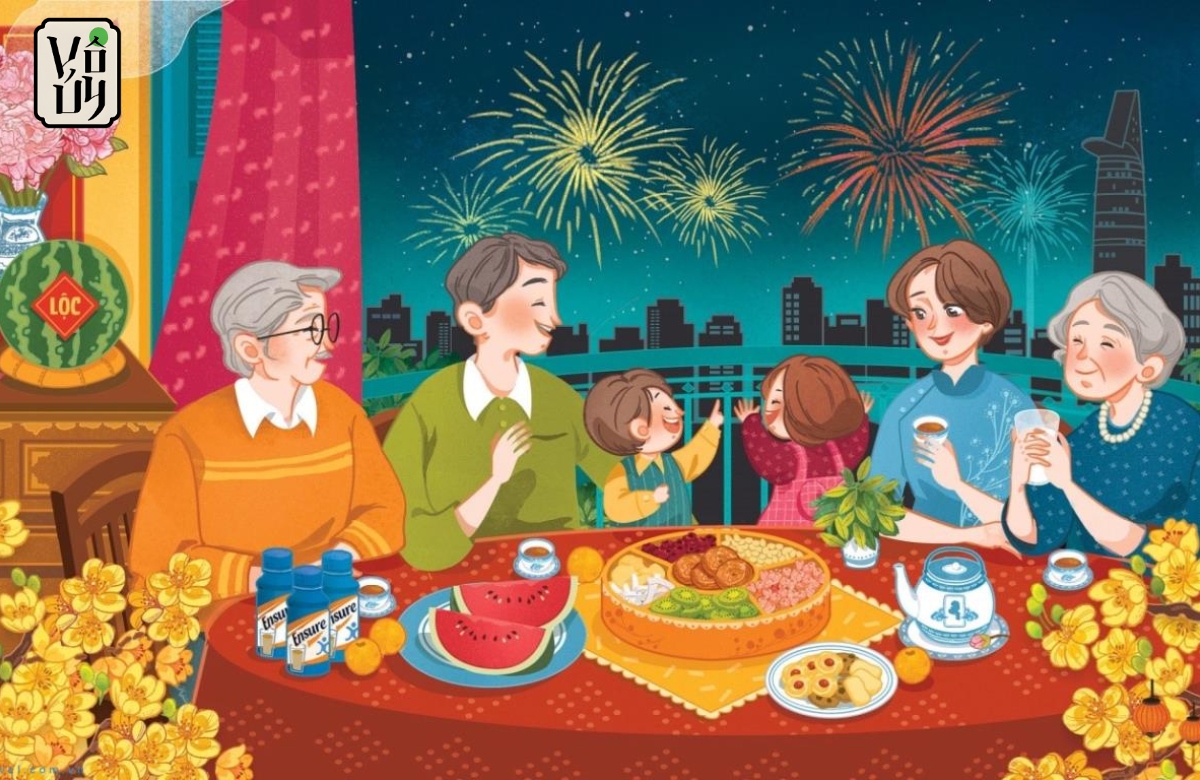
During the transition from the old year to the new year, Vietnamese people observe various taboos with the hope of welcoming wealth, health, and peace. These taboos reflect not only spiritual beliefs but also cultural behavior and family harmony.
Things to avoid on New Year’s Eve include:
-
Avoid arguing or raising voices: Conflicts at the beginning of the year are believed to bring discord throughout the year.
-
Avoid breaking objects or making loud noises: Breakage symbolizes loss, financial depletion, and bad luck.
-
Avoid looking into mirrors late at night: Folk beliefs say this may bring unease or negative energy at the start of the year.
-
Avoid using scissors or knives: Cutting actions symbolize cutting away fortune and luck.
-
Do not open safes or withdraw money: This is believed to cause financial loss at the very start of the year.
-
Avoid taking out trash or drying clothes: This symbolizes “throwing wealth away” and losing good fortune.
-
Avoid eating plain rice porridge or finishing the tail of a fish: These acts symbolize poverty or “using up” fortune.
-
Avoid wearing white or black clothing: These colors are associated with mourning; instead, red or bright colors are preferred to enhance positive energy.
-
Do not go to sleep too early: Traditional belief holds that sleeping early may cause one to miss the arrival of positive energy and luck for the new year.
These taboos are symbolic reminders for families to maintain joy, harmony, and welcome auspicious blessings in the new year.
Things to Avoid on New Year’s Eve
Frequently Asked Questions About New Year’s Eve Prayers
When should the indoor New Year’s Eve prayer be performed, and which direction should one face?
Typically, the prayer is performed around 11:00 PM on the last day of the lunar year, a time believed to harmonize yin and yang. When praying, it is customary to face the main entrance or the Southeast direction according to feng shui beliefs to welcome positive energy for the new year.
Should the entire family participate in the New Year’s Eve prayer, or is one representative sufficient?
Ideally, all family members participate to enhance solemnity and family bonding. However, if circumstances do not allow, the head of the household may represent the family as long as sincerity is maintained.
Is it acceptable to read the New Year’s Eve prayer from a phone?
Yes, reading the prayer from a phone is acceptable to avoid mistakes. However, one should remain focused and minimize distractions. Many families prefer printed copies or memorization to create a more solemn and sacred atmosphere.
Frequently Asked Questions About New Year’s Eve Prayers
Conclusion
The New Year’s Eve prayer is a ritual through which families express wishes for peace, good fortune, and prosperity as the new year begins. After the ceremony, many families choose to eat vegetarian meals as a way to purify the body and mind, starting the year gently and mindfully. If you wish to enjoy light vegetarian cuisine in a warm and welcoming setting, you may visit Vo Uy Vegetarian Restaurant to experience its refined plant-based menu and attentive service.